You’ve got a chore to tackle, that driveway needs a good scrub, the patio is looking grimy, or perhaps the siding on your house is sporting a less-than-ideal patina. You reach for your Ryobi electric pressure washer, anticipation building for the satisfying roar of the motor and the powerful blast of water that will bring everything back to pristine. You flip the switch, and… nothing. Well, not nothing, exactly. You hear a distinct hum, a low, persistent drone that suggests the motor is trying, but it’s just not engaging. The water, the real workhorse, remains stubbornly in the hose. Frustrating? Absolutely. But before you resign yourself to manually scrubbing, know this: troubleshooting a Ryobi electric pressure washer with a motor that hums but won’t start is a common issue, and often, you can fix it yourself with a little patience and a systematic approach.
This guide is designed to walk you through the process, arming you with the knowledge to diagnose the problem and get your powerful cleaning tool back in action. We’ll delve into the most probable culprits, explore step-by-step solutions, and offer tips to prevent future issues. So, grab your toolkit, prepare for a bit of hands-on investigation, and let’s get your Ryobi humming with purpose, not just with a frustrating lament.
The hum is your first clue, and it’s a critical one. It tells you that your pressure washer is receiving power. The electrical current is reaching the motor, causing its internal components to vibrate. This is a good sign, as it rules out a complete power supply failure, a tripped breaker at the source, or a faulty power cord that’s completely severed. However, it also indicates that something is preventing the motor from completing its rotational cycle and generating the necessary pressure. Think of it like a car engine that’s trying to turn over but isn’t firing on all cylinders. The motor assembly itself is energized, but the mechanism that translates that electrical energy into kinetic energy – the spinning of the pump and the subsequent water expulsion – is being hindered.
Understanding this initial symptom is the first step in isolating the problem. The hum is the sound of potential, but the lack of water pressure is the sound of a blockage, a mechanical obstruction, or an electrical component that’s not quite doing its job. We’re not dealing with dead electronics; we’re dealing with an impedance, a point of resistance that’s stopping the show.
What the Hum Actually Means
The hum you hear is the stator winding within the electric motor being energized by the alternating current. This creates a fluctuating magnetic field. Normally, this field would interact with the rotor, causing it to spin. When the motor hums but doesn’t spin, it means the magnetic field is present, but the rotor is either stuck, unable to overcome inertia, or a safety mechanism is preventing it from engaging fully. It’s a testament to the ingenuity of these machines that even a stalled motor will still generate a magnetic hum.

- 1800 PSI Electric Pressure Washer
- Trigger Handle with M22 Connections
- Spray Wand
- 15 Degree Nozzle, Soap Nozzle & Turbo Nozzle
- Operators Manual

- 1800 PSI 1.2 GPM
- 13 Amp electric motor
- Lightweight, portable design
- 15° nozzle and Turbo nozzle for 50% faster cleaning
- Soap applicator for detergent application

- AUTOMOTIVE CLEANING POWER: Ryobi pressure washer delivers strong, consistent water pressure to tackle tough dirt, grime, and grease on vehicles.
- VERSATILE USE: Ideal for washing cars, trucks, motorcycles, and other vehicles, as well as driveways and outdoor surfaces.
- EFFICIENT PERFORMANCE: Designed to provide powerful water flow, making automotive cleaning faster and more effective than a standard garden hose.
- DURABLE CONSTRUCTION: Built with high-quality materials to withstand regular use and deliver long-lasting, reliable performance.
- EASY TO USE: Straightforward setup and operation make this Ryobi pressure washer a convenient tool for both beginners and experienced users.

- POWERFUL PERFORMANCE: Delivers 2100 PSI and 1.2 GPM of cold water pressure, making it ideal for cleaning decks, sidewalks, fencing, siding, windows, and more.
- VERSATILE NOZZLE OPTIONS: Includes a 15° nozzle for precise, controlled cleaning and a turbo nozzle that blasts away tough dirt and grime up to 50% faster than a standard nozzle.
- DEEP CLEANING WITH FOAMER: The included foamer sprays a thick layer of detergent to tackle embedded grime, providing a thorough deep clean on a variety of surfaces.
- EXTENDED REACH: Features a 25 ft. non-marring high-pressure hose that gives you extended reach without scratching or marking surfaces during use.
- CONVENIENT STORAGE & PORTABILITY: Maximum on-board storage keeps all accessories organized on the tool, while the telescoping handle and wheels make transporting the unit effortless.

- Delivers 2500 max PSI and 1.76 max GPM (at lowest pressure), and 2000 rated PSI and 1.2 rated GPM of water flow; Pro-style steel extendable 17.5” wand with quick-connect nozzles (0°, 15°, 25°, turbo and soap applicator)
- Super compact and lightweight at 16.5” tall and 19 pounds for convenient storage and portability; Four quick-lock wheels with 360° steering design and low center of gravity engineered for anti-tipping design
- Easy-coil nylon braided 25' hose; 20 ounce onboard soap tank to add detergents/chemicals for heavy duty cleaning power on decks, driveways, garage floors, stairs, fencing, patio furniture and vehicles
- Pump automatically stops when trigger is not engaged to conserve energy and promote pump and motor life
- Backed by a 3-Year limited service, labor and parts coverage with nationwide customer service and support network


- Powerful Cleaning Performance: Equipped with a high‑efficiency brushless motor, it delivers up to 1,450 PSI and 3.0 GPM flow—6× more powerful than a standard garden hose. It blasts away stubborn grime on cars, patios, walls, and other outdoor surfaces in seconds for a fast, thorough clean.
- Cordless Power, Multi‑Angle Clean: Dual 4.0Ah batteries with fast charging give you up to 30 minutes of continuous use on a full charge. No cord to hold you back — clean wherever you want. It comes with a 6‑in‑1 nozzle that lets you easily switch modes by simply rotating: 0°, 15°, 25°, 40°, a wide spray, and a 45° angled tip that’s perfect for cleaning the undercarriage and wheel arches.
- Universal Water Source Compatibility: The kit comes with multiple adapters to connect to faucets, buckets, pools, rivers, or garden hoses, fitting all standard connections on the market for hassle‑free water access. A built‑in shut‑off valve lets you cut the water flow right at the unit—no need to run back to the faucet. The 16.4‑ft flexible hose and weighted filter block debris, ensuring a steady, clean water supply.
- Lightweight & Neatly Stored: Weighing only 2.18 lbs, it’s easy to carry with one hand. The included waterproof hard case keeps everything organized—the unit, foam cannon, 6‑in‑1 nozzle, two batteries, charger, hose, filter, adapters, shut‑off valve, and manual—all compactly packed in your trunk for grab‑and‑go convenience.
- Easy Setup, Quick to Use: We’ve simplified the design to eliminate complicated installation steps, so anyone can get started with ease. The included instruction guide walks you through assembly and connection in no time. Lightweight and compact, it saves space and stores conveniently in your garage, yard, or vehicle.

- 2000 psi and 1.2 GPM for efficient cleaning of residential areas
- 13 Amp electric motor effectively cleans a wide range of surfaces
- Durable frame with wheels and telescoping handle
- Turbo nozzle for up to 50percent more cleaning power
- On board detergent tank and accessory storage
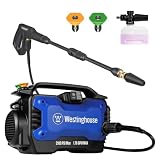
- BIG POWER. SMALL DESIGN: Delivers an impressive 2100 max PSI and 1.76 max GPM at lowest pressure, with 1800 rated PSI and 1.2 rated GPM so you're able to handle a range of tough jobs
- GRAB-AND-GO CLEANING: The ultra compact 10 pound electric pressure washer is easy to use, carry and store for everyday outdoor cleanups, wherever and whenever you find them
- ORGANIZED FOR EASY SETUP AND STORAGE: Built-in holders keep the spray gun, lance and standard spray nozzles together between jobs so it's always ready to grab and go
- SUPER SOAPER: The adjustable foam cannon lets you apply thick, clinging foam to loosen grease, grime and stains from cars, windows, decks and more
- GO GET THE GRIME: Enjoy extended reach with a 35 foot GFCI power cord and 20 foot high-pressure hose so you can walk and wash all around vehicles and outdoor spaces

- Delivers 2100 max PSI and 1.76 max GPM (at lowest pressure), and 1800 rated PSI and 1.2 rated GPM of water flow.
- Super compact and lightweight at 18 pounds for convenient storage and portability; Built-in handle for easy transportation to wherever your cleaning tasks are
- Easy-coil nylon braided 20’ hose; Detachable foam cannon to add detergents or chemicals for heavy duty cleaning power on decks, driveways, garage floors, stairs, fencing, patio furniture and vehicles
- Pump automatically stops when trigger is not engaged to conserve energy and promote pump and motor life
- Backed by 3-year limited service, labor and parts coverage with nationwide customer service and support network

- HIGH PRESSURE WASHER: LWQ power washer with deep cleaning high pressure up to 2.5 GPM of water flow. It's saving water and energy, it also ensures high cleaning efficiency and the ability to clean objects with complex shapes and structures, which makes it ideal for cleaning various surfaces in your home, such as driveways, patio furniture, and cars.
- MULTI-PURPOSE USE: Equipped with 4 quick-connect metal spray nozzles (water-pressure strength:0°>15°> 25°> 40°) and a foam cannon, the LWQ pressure washer is easy to clean objects with complex shapes and structures. The detergent bottle can be filled with chemicals such as bleach, the cleaner will not pass through the pump.
- CONVENIENT TO USE: LWQ Pressure Washer designs of 2 rollers for easy movement and operation, while the bottom of the body adds an anti-tipping design for overall stability when not in motion. Simple assembly + dual-roller design + anti-tipping base + faucet/bucket water collection system - making it more convenient to use anywhere.
- EASY TO STORAGE: With power cord hook and nozzle holders, it is easy to access or to store in a garage/pantry after use. In addition, its compact design for easy to store in a garage or pantry when not in use. The LWQ pressure washer is perfect for cleaning concrete, pavement, driveways, patios, decks, sidewalks, RVs, cars, boats, homes, fencing, and more.
- USER-FRIENDLY & SAFETY: The LWQ pressure washer using high-pressure water flow to clean up the dirt, for saving water and energy and ensuring high cleaning efficiency. Tip: Before turning on the pressure washer, exhaust the air in the high pressure hose as well as the inlet hose, this will ensure that the machine can spray high pressure water stream properly.
Common Scenarios Leading to a Hum
- Water Supply Issues: Even though the motor is humming, a lack of water entering the pump can indirectly cause the motor to struggle and appear as if it’s not starting properly. The motor might be trying to spin a pump that’s effectively running dry, which can trigger overload protection or simply be too much resistance.
- Internal Blockages: Debris or solidified mineral deposits within the pump or inlet/outlet lines can physically impede the motor’s ability to turn.
- Pump Seal Issues: Worn or damaged pump seals can lead to internal leaks, preventing pressure build-up and potentially causing the motor to chug.
- Overload Protection: Many pressure washers have thermal overload protectors that will shut down the motor if it gets too hot or draws too much current. A consistent hum without starting could be the protector repeatedly tripping.
- Electrical Interruption Downstream: While power is reaching the motor, a fault within the motor or its direct electrical connections could be preventing full rotation.
If you’re experiencing issues with your Ryobi electric pressure washer where the motor hums but won’t start, you might find helpful insights in a related article that discusses the benefits of using an electric power washer for home improvement projects. This article not only highlights the efficiency of electric pressure washers but also provides tips on troubleshooting common problems. For more information, you can read the article here: Revamp Your Home with an Electric Power Washer.
The Water Supply Check: The First Line of Defense
Before you even consider delving into the mechanical intricacies of your Ryobi pressure washer, you must confirm that water is flowing freely into the unit. This is the simplest and most common reason for a motor that hums but won’t start. The motor is designed to drive a pump that’s submerged in water, or at least have a consistent flow pushing into it. Trying to spin a pump that’s only filled with air, or worse, struggling against a vacuum, is a recipe for the humming without starting you’re experiencing.
You might be thinking, “But I have the hose connected!” and that’s great, but a connected hose doesn’t always mean a flowing hose. There are several points of failure in the water supply chain that can lead to this situation.
Ensuring Adequate Water Flow
- Water Source Pressure: Is the faucet you’re connected to providing sufficient water pressure? While electric pressure washers are less demanding than gas-powered ones, they still need a decent supply. Turn the faucet on fully and check the flow from the faucet itself. If the faucet output is weak, the pressure washer won’t stand a chance.
- Hose Kinks and Obstructions: This sounds obvious, but it’s incredibly easy to overlook. Walk the entire length of your garden hose from the faucet to the pressure washer. Are there any sharp bends or kinks? Even a subtle flattened section can significantly restrict water flow. Uncoil the hose and lay it out straight to be sure.
- Faucet Valve Fully Open: Double-check that the handle on your outdoor faucet is turned all the way to its fully open position. Sometimes, a valve might feel open but is only partially engaged, leading to reduced flow.
- Inlet Filter/Screen: Most Ryobi pressure washers have a filter screen on the water inlet to prevent debris from entering the pump. This is a prime suspect for blockages.
Checking and Cleaning the Inlet Filter
- Locate the Inlet: Identify the connection point where your garden hose attaches to the pressure washer.
- Disconnect the Hose: Be sure the pressure washer is unplugged from the power source before proceeding.
- Examine the Filter: Look closely at the inlet fitting. You’ll likely see a fine mesh screen, often housed in a plastic or metal housing.
- Remove the Filter: Depending on your model, the filter might unscrew or have a clip holding it in place. Carefully remove it.
- Clean Thoroughly: Rinse the filter under running water. Use a soft brush (an old toothbrush works well) to gently scrub away any dirt, sand, algae, or other debris. For stubborn build-up, you might soak it in a mild soap and water solution.
- Inspect for Damage: While cleaning, check the filter for any tears or holes. A damaged filter might not effectively protect the pump and could have allowed debris to pass through. If damaged, it will need replacing.
- Reinstall: Once clean and dry, carefully reinsert the filter, ensuring it’s seated properly.
- Reconnect Hose and Test: Reattach your garden hose and turn on the water. Check for leaks at the connection. Then, plug in the pressure washer and try starting it again.
Internal Blockages and Air Pockets

If you’ve confirmed a robust water supply and the inlet filter is clean, the next logical step is to investigate potential blockages within the pressure washer itself, or the presence of air pockets that are preventing the pump from priming. Air in the system can act much like a physical blockage, because the pump is designed to move incompressible liquid, not compressible air.
Purging Air from the System
- The “Run Dry” Test (with caution): With the pressure washer plugged in, the water source on, and the trigger released (not squeezed), allow the unit to run for a short period, perhaps 30 seconds to a minute. This can sometimes help push any trapped air out through the pump. Be careful not to let it run dry for too long, as this can damage the pump seals. You might hear sputtering sounds as the air is expelled.
- Check High-Pressure Hose and Wand: Ensure there are no kinks or blockages in your high-pressure hose or the wand assembly. Disconnect the high-pressure hose from the pressure washer’s outlet and the wand from the hose, and visually inspect them for any obstructions.
Investigating Pump Blockages
If purging air doesn’t solve the issue, it’s time to consider if something is truly lodged within the pump itself. This is less common with proper filter maintenance but can happen.
- Inspect the Pump Outlet: With the pressure washer unplugged and disconnected from water, disconnect the high-pressure hose from the rear of the unit. Look into the outlet port of the pump. Can you see any obvious debris?
- Gentle Probing (Use extreme caution): If you see something, you might be able to carefully dislodge it with a thin, non-metallic object like a wooden skewer or a plastic rod. Never use anything metal that could scratch or damage the internal components. Be gentle and methodical. The goal is to nudge the obstruction, not force it.
- Consider Detergent Injector Blockages: If your Ryobi has a detergent injector system, the small orifice here can also become blocked with dried detergent. You may need to disconnect the detergent tube and inspect or clear this port.
Electrical Components and Safety Features

While the external water supply and obvious internal blockages are the most frequent culprits, we also need to consider the electrical side of things, beyond just the power cord. Ryobi pressure washers, like most well-designed appliances, incorporate safety features to protect both you and the unit. A humming motor that won’t start could indicate one of these features is engaged, preventing operation.
Thermal Overload Protector
Many electric pressure washers are equipped with a thermal overload protector. This is a small device, often integrated into the motor housing or cord, that detects excessive heat. If the motor draws too much current or overheats due to a prolonged stalled state (the hum you’re hearing), this protector will trip, shutting off power to the motor.
- Allow for Cooling: The most straightforward solution here is simply to let the pressure washer cool down. Unplug it from the power source and let it sit for at least 30 minutes, or even an hour. This gives the thermal protector a chance to reset.
- Identify the Cause of Overheating: Once it cools, try starting it again. If it hums and then stops, or hums and still won’t start, you need to figure out why it’s overheating. Is the motor struggling due to a minor obstruction you haven’t quite cleared? Is there an issue with the motor windings themselves (less likely but possible)?
Capacitor Issues
Electric motors, especially those designed for starting under load, often utilize capacitors. These components store electrical energy and release it to give the motor a strong initial “kick” to get it spinning. A faulty or dead capacitor is a very common reason for a motor to hum but not start. The motor gets power, the magnetic field is established, but without the capacitor’s boost, it can’t overcome its own inertia.
- Identifying a Bad Capacitor: This is a bit trickier to diagnose visually without specialized tools. However, if you’ve exhausted all other possibilities, a bad capacitor becomes a strong suspect. Sometimes, you might notice a bulge or leakage on the capacitor itself, but often they fail internally without obvious external signs.
- Replacement: Replacing a capacitor is a task that requires some electrical comfort. You’ll need to identify the correct capacitor specifications (voltage and microfarad rating), safely discharge the old capacitor (crucial for safety!), and then install the new one. If you’re not comfortable with this, it’s best to seek professional help.
Loose Electrical Connections
While not as common as water supply or capacitor issues, loose electrical connections within the pressure washer’s housing can also lead to this problem. Vibration or improper assembly could cause a wire to become dislodged or have poor contact.
- Safety First: Always ensure the unit is unplugged from the power source before attempting to open any housing.
- Inspect Visible Connections: If you’re comfortable removing some of the outer casing (consult your user manual for guidance on disassembly), carefully inspect all visible electrical connections. Look for wires that are disconnected, frayed, or appear loose at their terminal points.
- Gentle Wiggling Test: With the power off, you can carefully and gently wiggle wire connections to see if any come loose. If you find a loose connection, ensure it’s securely reattached.
If you’re experiencing issues with your Ryobi electric pressure washer where the motor hums but won’t start, it may be helpful to explore potential solutions and troubleshooting tips. One related article that can provide valuable insights is about the essential soaps, detergents, and chemicals to use with pressure washers. Understanding the right cleaning agents can sometimes impact the performance of your machine. You can read more about this topic by visiting this guide, which offers a comprehensive overview of the best practices for using these products effectively.
The Pump Itself: Mechanical Troubles
| Issue | Possible Cause | Solution |
|---|---|---|
| Motor Hums but Won’t Start | Low water pressure, faulty power supply, clogged nozzle, or motor overload | Check water supply, clean nozzle, ensure proper power supply, and allow motor to cool down |
The pump is the heart of your pressure washer, and if it’s experiencing mechanical difficulties, the motor will dutifully hum in protest, unable to achieve the required rotational force. We’ve touched upon blockages, but there are other internal pump issues that can lead to this specific symptom.
Worn or Damaged Pump Seals
The pump relies on seals to maintain internal pressure and prevent leaks. If these seals are worn, cracked, or damaged, water can bypass internal components, making it impossible for the pump to build pressure. This places an excessive load on the motor.
- Signs of Seal Failure: While not always obvious without disassembly, you might notice consistent dripping from the pump housing, even when the unit is off and all water has drained.
- Repair or Replacement: Replacing pump seals typically involves disassembling the pump head. This can be a moderately complex repair. If your Ryobi is still under warranty, contact customer support. If not, you can often find repair kits for your specific model, or you may consider professional servicing or even replacing the entire pump assembly if it’s a more involved failure.
Damaged Pump Internals
Less frequently, the internal components of the pump itself – such as pistons, plungers, or valves – can become damaged due to running dry, ingesting debris, or simply wear and tear.
- Diagnosis Challenges: Diagnosing internal pump damage without disassembly is difficult. The hum without starting is often the primary indicator.
- Decision Time: If you suspect severe internal pump damage, and a repair kit or professional servicing is costly, you might need to weigh the cost of repair against the cost of a new pressure washer.
If you’re experiencing issues with your Ryobi electric pressure washer where the motor hums but won’t start, you might find helpful insights in a related article that discusses various troubleshooting techniques. Understanding the common problems and solutions can make a significant difference in getting your pressure washer back in working order. For more detailed information on exterior cleaning techniques and tips that can enhance your pressure washing experience, check out this informative guide here.
Advanced Troubleshooting and When to Seek Help
You’ve meticulously worked through the previous steps: confirmed water flow, cleared filters, purged air, allowed for cooling, and even considered internal pump issues. If your Ryobi electric pressure washer is still humming without starting, it’s time for some more advanced considerations or to accept that professional intervention might be necessary.
The Role of the High-Pressure Nozzle
While it seems counterintuitive, the nozzle plays a crucial role in pressure generation. If the nozzle is severely clogged or damaged, it can impede high-pressure water flow to the point where the motor struggles.
- Inspect the Nozzle:
- Disconnect Spray Wand: With the unit unplugged and water source off, disconnect the spray wand from the high-pressure hose.
- Examine the Nozzle Tip: Look closely at the opening of the nozzle. Is it clogged with dirt, paint, or mineral deposits?
- Clean or Replace: Use a thin wire or a specialized nozzle cleaning tool (often included with pressure washers) to carefully clean out any debris. If the nozzle appears physically damaged or excessively worn, it’s best to replace it. Ryobi often uses quick-connect nozzle tips, making replacement straightforward.
- Test Without Nozzle (Briefly): For a very brief test, you could carefully try starting the unit with the high-pressure hose attached but no nozzle or wand. If it starts and pumps water (even if it’s just a dribble), it points strongly to a nozzle or wand issue. Do not run it for more than a few seconds like this, as it can cause pump damage.
Internal Circuitry and Electronics
If you’ve reached this point, it’s possible there’s an issue with internal wiring, the power switch itself, or other electronic components that are beyond simple visual inspection.
- User Manual is Your Friend: Consult your Ryobi pressure washer’s user manual. It may offer more specific troubleshooting steps for your model or provide diagrams of internal components.
- Professional Service: For issues involving internal circuitry, motor windings, or complex electronic failures, it’s often best to seek assistance from a qualified appliance repair technician or an authorized Ryobi service center. Tampering with internal electronics without the proper knowledge and safety precautions can be dangerous and may void any remaining warranty.
When to Call a Professional
- Warranty in Effect: If your Ryobi pressure washer is still under its manufacturer’s warranty, attempting extensive repairs yourself could void it. Contact Ryobi customer support for guidance.
- Lack of Mechanical/Electrical Comfort: If you’re not comfortable with electrical components, disassembly, or mechanical repairs, it’s always safer to entrust the job to a professional.
- Suspected Major Component Failure: If you suspect a failure of the motor itself, the pump assembly, or significant electrical components, professional diagnosis can save you time and potential further damage.
- Repeated Failures: If you’ve fixed one issue only to have another problem arise, it might indicate a more systemic problem that a professional can identify and rectify.
Troubleshooting a Ryobi electric pressure washer that hums but won’t start can be a process of elimination. By systematically working through these potential causes, from the simple to the more complex, you’ll be well-equipped to get your cleaning machine back in working order. Remember to always prioritize safety, unplug the unit, and disconnect from water sources before performing any internal checks or repairs. Happy cleaning!
Leave a Reply