You’ve decided your balcony needs a thorough clean. Whether it’s accumulated dust, bird droppings, or stubborn grime that’s built up over the seasons, a good electric pressure washer can make a significant difference. Unlike gas-powered models, electric pressure washers are generally lighter, quieter, and produce no emissions, making them ideal for urban environments and apartment living where noise and fumes are a concern.
When choosing a pressure washer for your balcony, you need to consider several factors. Portability is key, as you’ll likely be moving it around a confined space. Power output, measured in Pounds per Square Inch (PSI) and Gallons Per Minute (GPM), will determine how effectively it cleans different surfaces. Finally, features like hose length, nozzle types, and storage options will impact your overall experience. This guide will help you navigate the options and select the best electric pressure washer for your balcony cleaning needs.
Before you dive into specific models, it’s crucial to grasp the terminology used to describe pressure washer capabilities. These specifications dictate how effective a unit will be for various cleaning tasks.
Pounds per Square Inch (PSI)
PSI measures the force with which water is expelled from the nozzle. For balcony cleaning, you don’t typically need a commercial-grade pressure washer with extremely high PSI.
- Low-Duty (1300-1700 PSI): These are suitable for light cleaning tasks. Think rinsing off loose dirt, hosing down patio furniture, or washing delicate outdoor fabrics. They are generally gentler on surfaces and less likely to cause damage. If your balcony is primarily made of wood or has painted surfaces, a lower PSI might be more appropriate.
- Medium-Duty (1700-2000 PSI): This range is often considered the sweet spot for general home use, including balcony cleaning. It’s powerful enough to tackle most common grime, moss, and mildew without being overly aggressive. Concrete, stucco, and most tile surfaces can handle this pressure without issue.
- High-Duty (2000+ PSI): While some electric models reach this level, it’s generally overkill for routine balcony cleaning. You might use this for very stubborn stains on concrete or brick, but extreme caution is advised to avoid damaging surfaces like grout, mortar, or softer decking materials. If you opt for a higher PSI, always start with the widest nozzle and from a distance.

- Delivers 2500 max PSI and 1.76 max GPM (at lowest pressure), and 2000 rated PSI and 1.2 rated GPM of water flow; Pro-style steel extendable 17.5” wand with quick-connect nozzles (0°, 15°, 25°, turbo and soap applicator)
- Super compact and lightweight at 16.5” tall and 19 pounds for convenient storage and portability; Four quick-lock wheels with 360° steering design and low center of gravity engineered for anti-tipping design
- Easy-coil nylon braided 25' hose; 20 ounce onboard soap tank to add detergents/chemicals for heavy duty cleaning power on decks, driveways, garage floors, stairs, fencing, patio furniture and vehicles
- Pump automatically stops when trigger is not engaged to conserve energy and promote pump and motor life
- Backed by a 3-Year limited service, labor and parts coverage with nationwide customer service and support network


- HIGH PRESSURE WASHER: LWQ power washer with deep cleaning high pressure up to 2.5 GPM of water flow. It's saving water and energy, it also ensures high cleaning efficiency and the ability to clean objects with complex shapes and structures, which makes it ideal for cleaning various surfaces in your home, such as driveways, patio furniture, and cars.
- MULTI-PURPOSE USE: Equipped with 4 quick-connect metal spray nozzles (water-pressure strength:0°>15°> 25°> 40°) and a foam cannon, the LWQ pressure washer is easy to clean objects with complex shapes and structures. The detergent bottle can be filled with chemicals such as bleach, the cleaner will not pass through the pump.
- CONVENIENT TO USE: LWQ Pressure Washer designs of 2 rollers for easy movement and operation, while the bottom of the body adds an anti-tipping design for overall stability when not in motion. Simple assembly + dual-roller design + anti-tipping base + faucet/bucket water collection system - making it more convenient to use anywhere.
- EASY TO STORAGE: With power cord hook and nozzle holders, it is easy to access or to store in a garage/pantry after use. In addition, its compact design for easy to store in a garage or pantry when not in use. The LWQ pressure washer is perfect for cleaning concrete, pavement, driveways, patios, decks, sidewalks, RVs, cars, boats, homes, fencing, and more.
- USER-FRIENDLY & SAFETY: The LWQ pressure washer using high-pressure water flow to clean up the dirt, for saving water and energy and ensuring high cleaning efficiency. Tip: Before turning on the pressure washer, exhaust the air in the high pressure hose as well as the inlet hose, this will ensure that the machine can spray high pressure water stream properly.
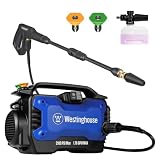
- BIG POWER. SMALL DESIGN: Delivers an impressive 2100 max PSI and 1.76 max GPM at lowest pressure, with 1800 rated PSI and 1.2 rated GPM so you're able to handle a range of tough jobs
- GRAB-AND-GO CLEANING: The ultra compact 10 pound electric pressure washer is easy to use, carry and store for everyday outdoor cleanups, wherever and whenever you find them
- ORGANIZED FOR EASY SETUP AND STORAGE: Built-in holders keep the spray gun, lance and standard spray nozzles together between jobs so it's always ready to grab and go
- SUPER SOAPER: The adjustable foam cannon lets you apply thick, clinging foam to loosen grease, grime and stains from cars, windows, decks and more
- GO GET THE GRIME: Enjoy extended reach with a 35 foot GFCI power cord and 20 foot high-pressure hose so you can walk and wash all around vehicles and outdoor spaces

- Delivers 3000 max PSI and 1.76 max GPM (at lowest pressure), and 2600 rated PSI and 1.1 rated GPM of water flow. Perfect for decks, sidewalks, fences, garage floors, exterior walls, cars and patio furniture; Comes with a .45 gallon soap tank
- 25′ abrasion resistant super-flex hose with lightweight high pressure metal spray gun and wand with 5 quick connect nozzles (0°, 15°, 25°, soap and turbo); Compatible with pressure washer accessories like surface cleaners, undercarriage cleaners and foam cannons with M22 fittings
- Heavy duty AC 120V electric motor and long-lasting, maintenance-free axial 3 piston auto-stop pump provides up to 1.76 gallons of water (and soap) a minute
- Rugged steel frame with high profile 10” never-flat wheels and 35’ GFCI cord provide easy transportation and maneuverability; Includes tools and quick start guide to get cleaning in minutes
- All Westinghouse pressure washers are functionally tested in the factory and are backed by 3-year limited manufacturer service, labor and parts coverage

- Delivers 2100 max PSI and 1.76 max GPM (at lowest pressure), and 1800 rated PSI and 1.2 rated GPM of water flow.
- Super compact and lightweight at 18 pounds for convenient storage and portability; Built-in handle for easy transportation to wherever your cleaning tasks are
- Easy-coil nylon braided 20’ hose; Detachable foam cannon to add detergents or chemicals for heavy duty cleaning power on decks, driveways, garage floors, stairs, fencing, patio furniture and vehicles
- Pump automatically stops when trigger is not engaged to conserve energy and promote pump and motor life
- Backed by 3-year limited service, labor and parts coverage with nationwide customer service and support network

- Delivers 2300 max PSI and 1.76 max GPM (at lowest pressure), and 1900 rated PSI and 1.24 rated GPM of water flow; Pro-style steel extendable 17.5” wand with quick-connect nozzles (0°, 15°, 25°, turbo and soap applicator)
- Super compact and lightweight at 16.5” tall and 19 pounds for convenient storage and portability; Four quick-lock wheels with 360° steering design and low center of gravity engineered for anti-tipping design
- Easy-coil nylon braided 25' hose; 20 ounce onboard soap tank to add detergents/chemicals for heavy duty cleaning power on decks, driveways, garage floors, stairs, fencing, patio furniture and vehicles
- Pump automatically stops when trigger is not engaged to conserve energy and promote pump and motor life
- Backed by a 3-year limited service, labor and parts coverage with nationwide customer service and support network

- TRUBRUSHLESS MOTOR : Powerful 14 Amp TruBrushless motor generates 3000 PSI and 2.0 GPM for maximum cleaning power.Cleaning Units 3300 C.U. Maximum Inlet Water Temperature 104°F (40°C).
- All water pressure (PSI) and flow rate (GPM) claims for this product were tested and verified by an independent lab, ensuring you’ll take home the power you were promised
- JETTFLOW TECHNOLOGY : Delivers up to 50% more flow, reaching higher areas and quick power rinsing
- ACCESSORIES : Equipped with rugged metal gun and hassle-free 25-FT Uberflex kink-resistant hose; 15°, 25° and 40° tips, soap and turbo nozzles included

- POWERFUL CLEANING PERFORMANCE: Powered by a 1600W motor, this electric pressure washer delivers up to 2465 PSI max pressure and 1.76 max flow rated to break through dirt, grime, and buildup with less cleaning time and effort
- VERSATILE CLEANING NOZZLES: Includes 4 quick-connect spray tips: 0°, 15°, 25°, and 40°, plus a 0.4L detergent bottle for added cleaning power. Ideal for washing vehicles, fences, gates, driveways, and concrete patios with eco-friendly soap that helps reduce filter clogging and supports longer machine life
- EXTENDED REACH DESIGN: The 20 ft high-pressure hose and 35 ft power cord give you plenty of reach around your cleaning area without constantly repositioning the unit. Two smooth-rolling wheels make it easy to move the washer while maintaining steady balance
- AUTOMATIC SHUTOFF SAFETY: The automatic On/Off function stops the motor when the spray trigger is released, helping reduce unnecessary operation. An integrated trigger safety lock also helps prevent unintended spraying during storage or when the washer is not in use
- CONVENIENT ACCESSORY STORAGE: Keep essential accessories close at hand with the built-in power cord hook and convenient accessory holder for storing the hose, spray nozzles, and cord. The compact design fits easily into a garage, utility area, or pantry when cleaning is finished

- POWERFUL 13-AMP MOTOR — Delivers strong, consistent cleaning power to cut through dirt, grime, mud, and mildew on driveways, patios, decks, fences, vehicles, and more
- 4 QUICK-CONNECT NOZZLE TIPS INCLUDED — 0°, 15°, 25°, and 40° nozzles tailor your spray from a pinpoint jet to a wide, gentle fan for any cleaning task; nozzles store onboard for easy access
- ONBOARD DETERGENT SYSTEM — Includes a 13.53 oz foam bottle so you can apply pressure-washer-specific detergent directly through the spray wand for a deeper clean
- EXTENDED REACH — 20-ft hose and 35-ft GFCI-protected power cord give you plenty of range with fewer interruptions
- TOTAL STOP SYSTEM (TSS) — Automatically shuts off the motor when the trigger is released, reducing wear and conserving energy for a longer-lasting pump

- [1700 PSI @ 1.2 GPM] - Great for light-duty, residential cleaning. Clean cars, trucks, motorcycles, boats, RVs, outdoor patio furniture, windows, decks, etc
- [No Maintenance] - No gas, no oil, no spark plugs, no air filters, and no pull cord Push button start
- [35-FT Power Cord + GFCI Plug] - Integrated GFCI safety device auto shuts off electrical power, protecting you and your home
- [Accessories Included] - Pressure washer gun, 25° nozzle (general purpose cleaning), 40° nozzle (gentle cleaning), 20 FT tangle-free hose. 1/4" universal quick connect system
- [3 Year Limited Warranty] - Protects your investment against all defects in materials, parts or workmanship under normal use.
Gallons Per Minute (GPM)
GPM indicates the volume of water the machine delivers per minute. While PSI dictates the force, GPM influences how quickly you can complete a cleaning task.
- Lower GPM (1.0-1.4 GPM): Machines in this range are perfectly adequate for most balcony cleaning. They are water-efficient, which can be a consideration in areas with water restrictions or if you’re trying to minimize runoff.
- Higher GPM (1.5+ GPM): A higher GPM means you can cover more ground in less time, making the cleaning process faster. This can be beneficial if you have a larger balcony or are tackling particularly widespread dirt. However, it also means higher water consumption.
Combined Cleaning Power (CU)
Sometimes, manufacturers will advertise a “Cleaning Power” or “Cleaning Units” (CU) rating. This is calculated by multiplying PSI by GPM. A higher CU indicates a more powerful and effective cleaning machine overall. While not always explicitly stated, understanding how PSI and GPM contribute to this means you can make an informed decision yourself. A machine with 1500 PSI and 1.2 GPM (1800 CU) might be equally effective as one with 1400 PSI and 1.3 GPM (1820 CU) for general cleaning tasks.
When searching for the best electric pressure washer for balcony cleaning, it’s essential to consider various factors such as power, size, and ease of use. A great resource that complements this topic is an article discussing the advantages of wall-mounted electric pressure washers, which can be particularly beneficial for apartment dwellers with limited storage space. You can read more about it in this informative piece on efficient cleaning with wall-mounted electric pressure washers here. This article provides insights that can help you make an informed decision for maintaining a clean and tidy balcony.
Key Features for Balcony Cleaning
Beyond raw power, several design and functional aspects contribute to a pressure washer’s suitability for balcony use.
Portability and Storage
Given the often-limited space on balconies and in apartments, a compact and lightweight design is paramount.
- Weight: Look for models under 20 pounds if possible. Lighter units are easier to lift, carry, and maneuver around furniture or potted plants. Some units can be as light as 10-12 pounds.
- Wheels: While not strictly necessary for very small balconies, integrated wheels can make moving heavier units much simpler, especially if you need to transport it from indoors to your balcony. However, ensure the wheels are sturdy for their intended purpose.
- Compact Design: Models with a low profile or a vertical design are easier to store in small closets or utility areas when not in use. Some even feature folding handles to further reduce their footprint.
- Hose and Cord Management: Integrated hose reels and cord wraps are extremely useful. They prevent tangling, keep your workspace tidy, and make storage more convenient. Nothing is more frustrating than untangling a coiled hose before and after a cleaning session.
If you’re looking for the best electric pressure washer for balcony cleaning, you might also find useful tips in a related article that discusses DIY flooring options for your outdoor space. This guide provides insights into easy installation techniques that can complement your balcony cleaning efforts, ensuring that your area remains not only clean but also stylish. For more information on enhancing your balcony, check out the article on DIY flooring tips and tricks for easy installation.
Nozzle Types and Versatility
The type and number of nozzles included with your pressure washer will significantly impact its cleaning versatility. Different nozzles offer varying spray patterns and intensities.
- Interchangeable Nozzles: Most electric pressure washers come with several quick-connect nozzles, typically color-coded for easy identification:
- 0-degree (Red): A pinpoint, concentrated stream. Use with extreme caution as it can damage surfaces. Generally not recommended for balcony use unless you’re incredibly precise and know what you’re doing on very tough, durable surfaces like solid concrete.
- 15-degree (Yellow): A narrower, powerful fan spray for stubborn dirt and grime on hard surfaces. Good for targeted cleaning of embedded dirt.
- 25-degree (Green): A wider, general-purpose fan spray. This is a workhorse nozzle for most everyday cleaning tasks on balconies, including concrete, tiles, and some treated wood.
- 40-degree (White): The widest, gentlest fan spray. Ideal for rinsing, washing vehicles, and cleaning delicate surfaces like outdoor furniture, screens, or painted surfaces. This is often your starting point for any new surface.
- Soap Nozzle (Black/Blue): A low-pressure, wide-angle nozzle designed for applying detergent. It disperses soap evenly and is too gentle to clean without scrubbing.
- Adjustable Nozzles: Some pressure washers feature an adjustable nozzle that allows you to change the spray pattern (from pencil-thin to wide fan) by twisting the nozzle head. These can be convenient as they eliminate the need to switch out physical nozzles, saving time and potential hassle.
- Turbo Nozzles: These nozzles provide a rapidly rotating stream of water, offering a cleaning power similar to a narrow fan nozzle but covering a wider area. They can be very effective for removing tough grime and moss from concrete or brick, but always test on an inconspicuous area first.
Hose Length and Power Cord
These often-overlooked features are critical for practical use on a balcony.
- Pressure Hose Length: A longer hose offers greater reach and flexibility, reducing the need to constantly move the main unit.
- 20-25 feet: This is a good minimum for most balconies. It allows you to clean across the entire space without repositioning the pressure washer itself, especially if your balcony isn’t exceptionally large.
- 30+ feet: If you have a larger balcony or multiple outdoor areas you intend to clean (like a small patio or walkway), a longer hose will be a significant advantage.
- Power Cord Length: Similarly, a longer power cord provides more flexibility in where you set up the unit.
- 35 feet: A common and sufficient length.
- Ground Fault Circuit Interrupter (GFCI): Always ensure the power cord includes an integrated GFCI for safety, as you’ll be working with water and electricity. This is a standard safety feature for outdoor electrical equipment.
- Extension Cords: If you need to use an extension cord, ensure it’s rated for outdoor use (marked as “W” or “SJOW”) and has the appropriate gauge (thicker wire, lower gauge number) to handle the pressure washer’s power requirements safely. An undersized extension cord can cause voltage drops, diminish performance, and create a fire hazard.
Safety Considerations

Operating a pressure washer, even an electric one, requires adherence to safety protocols to prevent injury or damage.
Personal Protective Equipment (PPE)
- Eye Protection: Always wear safety glasses or goggles to shield your eyes from flying debris, water spray, and chemical splashes.
- Hearing Protection: While electric models are quieter than gas, prolonged exposure to even moderate noise can be damaging. Consider earplugs or earmuffs.
- Closed-Toe Shoes: Protect your feet from the high-pressure spray and any dropped equipment. Avoid sandals or open-toed footwear.
- Gloves: Can improve grip and protect your hands from prolonged exposure to water and cleaning agents.
Operating Practices
- Read the Manual: Before first use, thoroughly read and understand your specific model’s instruction manual.
- Inspect Equipment: Before each use, check the hose for kinks or damage, and ensure all connections are secure. A damaged hose can burst under pressure.
- Clear the Area: Remove any loose items, furniture, plants, or pets from the balcony before starting. The high-pressure spray can send objects flying or damage delicate items.
- Test on Inconspicuous Area: Always test the spray pattern and pressure on a small, hidden section of the surface you plan to clean. This helps you gauge the appropriate distance and nozzle type for that material.
- Maintain Distance: Never aim the nozzle at people, pets, or electrical outlets. Maintain a safe distance from the surface you’re cleaning to avoid damage. Start further away and move closer if necessary.
- Proper Grip: Hold the spray gun firmly with both hands, especially when pulling the trigger, as the recoil can be significant.
- Trigger Lock: Utilize the trigger safety lock when you’re not actively spraying to prevent accidental discharge.
- Unplug When Not in Use: Always unplug the pressure washer from the power outlet when performing maintenance, changing nozzles, or when finished cleaning.
- Water Source: Ensure a consistent water supply. Running a pressure washer without water can damage the pump.
Maintenance Tips for Longevity

Proper maintenance extends the life of your electric pressure washer and ensures it performs reliably.
After Each Use
- Depressurize: Turn off the pressure washer, then turn off the water supply. Pull the trigger on the spray gun to release any remaining pressure in the system.
- Drain Water: Disconnect the water inlet hose and the high-pressure hose. Allow all water to drain from the pump and hoses. This is particularly important if you live in an area where temperatures drop below freezing, as trapped water can freeze and damage internal components.
- Clean Nozzles: Remove any debris from the nozzle tips.
- Wipe Down: Clean the exterior of the unit with a damp cloth.
Seasonal Maintenance
- Indoor Storage: If storing the pressure washer for an extended period, particularly through winter months, bring it indoors to a dry, temperature-controlled environment.
- Pump Protector/Antifreeze: In colder climates, consider running a pump protector or non-toxic RV antifreeze through the pump before winter storage. Follow the manufacturer’s specific instructions for this process.
- Check Hoses and Connections: Before the cleaning season begins, inspect hoses for cracks, leaks, or signs of wear. Replace any damaged components.
By understanding these specifications, features, and safety guidelines, you can confidently choose an electric pressure washer that is well-suited for your balcony cleaning needs, ensuring a spotless and inviting outdoor space. Remember, investing a little time in research and adherence to proper procedures will save you time and potential frustration in the long run.
Leave a Reply