
You’re standing in your garage, staring at two gleaming electric pressure washers. One is advertised with a 13-amp motor, the other with a 15-amp motor. On the surface, they look the same, maybe a few handle differences, a slightly tweaked nozzle collection. But there’s a crucial distinction humming beneath that plastic casing, a difference that will ultimately dictate how effectively you tackle that grimy patio, the mildewed siding, or that caked-on mud from your car. This isn’t just about two numbers; it’s about understanding the heart of your cleaning machine and how it translates to power and performance. You need to decide which one is right for you, and understanding the nitty-gritty of these amperage ratings is the first step.
Let’s dive deep into what those seemingly small fluctuations in amperage actually mean for your pressure washing experience. It’s not about simply picking the bigger number; it’s about grasping the underlying electrical principles and how they manifest as brute cleaning force. You might have initially dismissed these specs as technical jargon, but by the end of this exploration, you’ll be armed with the knowledge to make an informed decision that saves you frustration and delivers superior results.
You’ve seen the numbers: 13 Amp, 15 Amp. They’re printed on the box, highlighted in online descriptions, and probably bandied about by sales assistants. But what does “amp” actually represent in the context of your electric pressure washer? And how does that translate from a simple electrical measurement to the real-world capability of your cleaning tool? Understanding this foundational concept is paramount to making the right choice.
Understanding the Basics: Amps as the Flow of Electricity
Think of electricity like water flowing through a pipe. The “amp” (or ampere) is the unit of measurement for the electrical current – essentially, how much electrical charge is flowing through the circuit per second. The higher the amperage, the greater the flow of electricity. In the context of your pressure washer motor, this increased flow directly fuels its ability to perform work.
The Analogy of the Garden Hose
Imagine you’re trying to wash your car with a garden hose. A 13-amp motor is like a garden hose with a pretty standard diameter. It can deliver a decent amount of water, enough for everyday tasks. You can get the dirt off, rinse away soap, and generally do a satisfactory job. Now, a 15-amp motor is like stepping up to a wider garden hose, or perhaps a hose with a higher water pressure setting. It can deliver more water, more forcefully, allowing you to blast away more stubborn grime and rinse more efficiently. This analogy, while simplified, captures the essence of what increased amperage signifies: enhanced capacity.
Beyond the Voltage: Wattage and Power Output
While amperage is a critical factor, it’s not the only one. You’ll also encounter “volts” (V) and “watts” (W) when looking at pressure washers. Voltage represents the electrical “pressure” driving the flow of current. Watts, on the other hand, represent the total power consumed by the motor. The relationship between these is crucial: Watts = Volts x Amps.
The Interplay of Voltage and Amperage
Electric pressure washers typically operate on a standard household voltage, usually around 120 volts in North America. This means that the differences in power output between a 13-amp and a 15-amp motor are directly linked to their amperage. If both are operating at the same voltage, the 15-amp motor will consume more power (watts) because it’s drawing more current. This increased power consumption is what ultimately allows it to generate more output.
Why Watts Matter for Cleaning Performance
The wattage of your pressure washer is a good indicator of its overall power. A higher wattage motor generally means it can more effectively spin the pump and generate higher water pressure (PSI – pounds per square inch) and flow rate (GPM – gallons per minute). So, while you’re looking at amps, you should also be considering how that amperage contributes to the overall wattage and, consequently, the cleaning muscle of your machine.
When considering the differences between 15 amp and 13 amp electric pressure washer motors, it’s essential to understand how these variations can impact performance and efficiency. For a more in-depth exploration of the cleaning power and features of portable power washers, you can refer to this informative article: Ultimate Cleaning Power: Portable Power Washer. This resource provides valuable insights that can help you make an informed decision based on your specific cleaning needs.
The Muscle Behind the Machine: How Amperage Translates to Cleaning Power
Now, let’s get down to the practical implications. You’re not buying a pressure washer for its electrical specifications; you’re buying it to clean. So, how does that seemingly minor 2-amp difference between a 13-amp and a 15-amp motor actually affect your cleaning tasks? The answer lies in the pressure and flow it can generate.

- Efficient Cleaning: Equipped with a powerful 120V 2HP motor and a premium triplex pump, this pressure washer pump kit delivers 1220 PSI of water pressure and up to 2.2 GPM of max flow for fast cleaning while remaining gentle on surfaces
- Easy Upgrade for Existing Pump Systems: Upgrade without re-piping. This triplex power washer pump is compatible with a wide range of brands and models. The 3/8" NPT outlet and 3/4" inlet ensure quick, secure connection to standard hoses and fittings
- Reduced Leaks: This triplex pump uses a crankshaft design with an unloader valve for steady pressure. The ceramic plunger and a brass head enhance sealing and rust resistance, while the 20CrMnTi body supports extended high-pressure use and reduces leaks
- Adjustable Pressure Design: Our electric pressure washer pump is built for flexible cleaning. Use high pressure for tough grime and lower pressure for delicate surfaces to meet different cleaning needs
- Wide Applications: Equipped with a 4.9 ft inlet hose, this power washer pump ensures steady high flow with minimal restriction for extended, efficient cleaning and flexible installation. It is ideal for patios, driveways, vehicles, and outdoor equipment


- Efficient Cleaning: Equipped with a powerful 120V 2HP motor and a premium triplex pump, this pressure washer pump kit delivers 1220 PSI of water pressure and up to 2.2 GPM of max flow for fast cleaning while remaining gentle on surfaces
- Easy Upgrade for Existing Pump Systems: Upgrade without re-piping. This triplex power washer pump is compatible with a wide range of brands and models. The 3/8" NPT outlet and 3/4" inlet ensure quick, secure connection to standard hoses and fittings
- Reduced Leaks: This triplex pump uses a crankshaft design with an unloader valve for steady pressure. The ceramic plunger and a brass head enhance sealing and rust resistance, while the 20CrMnTi body supports extended high-pressure use and reduces leaks
- Adjustable Pressure Design: Our electric pressure washer pump is built for flexible cleaning. Use high pressure for tough grime and lower pressure for delicate surfaces to meet different cleaning needs
- Wide Applications: This power washer pump includes a wall-mount bracket, 4.9 ft inlet hose, spray gun, wand, nozzles, and hooks. Designed to improve stability, flexibility, and ease of use, it's ideal for patios, driveways, vehicles, and outdoor equipment

- Tackle Stubborn Grime: Equipped with a powerful 240V 5HP motor and a premium triplex pump, this pressure washer pump kit for light commercial systems delivers up to 1950 PSI and 3.2 GPM for increased cleaning efficiency

- This pressure washer combines a Canpump 5 hp solid shaft electric motor and with an Italian-made Premium hollow shaft triplex pump(Bertolini WBH 2430-F). It provides the power you need for industrial cleaning maintenance and general-purpose cleaning. Max. pressure: 2400 psi (170 bar), Max. flow rate: 3.1 US gpm (11.7 L/min) [NOTE: This product ships in two boxes which may arrive separately. A signature is required for both packages at delivery.]
- Canpump CF 2530 EH | Max. pressure: 2500 psi (175 bar) | Max. flow rate: 2.9 US gpm (10.9 L/min) | Pump mechanism: Triplex plunger | Unloader valve: Detachable (bolt-on) unloader valve, pressure-adjustable with 20:1 detergent injector and built-in water filter | Inlet: ¾″ standard garden hose | Outlet: ⅜″ quick-connect | Oil grade: SAE 15W-40 oil
- Motor: Canpump - 5 hp (3.7 kW), NEMA 56C flange | Voltage: 230 V, 60 Hz, Single-Phase | Current: 22 amp Speed: 3,440 rpm | Inlet: ¾″ garden hose | Outlet: ⅜″ quick-connect | Gun: Quick-connect (includes battery and built-in sensor on remote control variant) | Nozzles: 5 quick-connect nozzles
- The Remote Control Total Stop System (TSS) is designed to automatically shut off the pump when the trigger is not engaged, enhancing energy efficiency and extending the pump’s lifespan. It uses a battery-operated trigger gun that sends a wireless signal to the module to control the machine based on the trigger position. It is specifically compatible with Canpump's wireless gun.
- Commercial-grade pump and motor fully serviceable through our line of spare parts and repair kits. Detachable unloader valve (pressure regulator) included. Completely customizable with our professional line of accessories of spray guns, foam kits, turbo rotating nozzles and more. Durable twist resistant wire-braided hose with quick connectors for easy assembly and transport
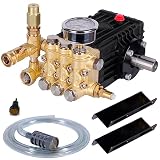
- ★【Pressure Washer Pump Specifications】3,600 psi at 4.0GPM(15LPM), 10 HP (Max 7.5 KW) at 1,450 rpm, 24 mm solid shaft, horizontal mount belt-drive, keyway, 3/4-inch standard garden hose inlet, 3/8-inch quick-connect outlet, 60°C (140°F) max. inlet water temperature
- ★【Universal Pressure Washer Parts】Replacement pressure washer pump kit with compatibility for belt-driven gas engine setups and hollow shaft electric motors made for 24 mm diameter shafts. This 24mm solid shaft pumps work with both gas-powered engines and electric-powered motors for many brands ,
- ★【Durable & Sturdy Pressure Washer Pump 】The washer pump features forged brass and anodized aluminum construction with cooling fins, for protection against corrosion; Durable 18 mm ceramic-coated solid stainless steel pistons deliver extended seal life; Dual oversized radial ball bearings are installed for better wear and friction resistance. Strengthened one-piece alloy aluminum connecting rod.
- ★【Triplex Plunger Pump】Fully detachable and pressure-adjustable internal bypass unloader valve with ergonomic control, detergent injector and built-in water filter; Triplex plunger pump mechanism; Thermal relief protection to prevent the pump overheating; Sight glass for oil inspection.
- ★【Easy Installation】 This replacement pump features a garden hose inlet and QC quick connect high pressure hose outlet. Each kit includes a detergent tube with filter, pressure guage, mounting bolts, installing rails-brackets to get your machine back in action as quickly as possible. (*Check your pressure washer's inlet and outlet orientation, mounting dimension to ensure compatibility)

- COMMERCIAL-GRADE PERFORMANCE: Built with a heavy-duty triplex plunger pump and a 2 HP 120V single-phase electric motor (1725 RPM), this pressure washer pump assembly delivers consistent 1500 PSI at 2.2 GPM for reliable high-pressure cleaning power. NOTE: Ships in multiple boxes; assembly required.
- PUMP SPECS: Max pressure 1500 PSI | Max flow 2.2 GPM | Triplex plunger mechanism | Unloader inlet 3/4″ standard garden hose | Unloader outlet 3/8″ quick connet | Pump inlet 1/2″ NPT F | Pump outlet 3/8″ NPT F | Oil grade: SAE 15W-40 oil | Includes detergent tube with strainer
- DETACHABLE UNLOADER VALVE: External (bolt-on) unloader (pressure regulator) with 20:1 detergent injector and built-in water filter allows quick pressure adjustments, easy servicing, and reliable safety performance — designed for frequent use in both home and professional settings
- VERSATILE CLEANING APPLICATIONS: Perfect for car washing, driveway and patio cleaning, siding and deck maintenance, garage and workshop use, and other residential or light commercial cleaning jobs requiring steady water flow and moderate pressure
- QUIETER & LONGER LASTING: Powered by a 1745 RPM motor that runs at half the speed of 3450 RPM units, reducing noise, vibration, and pump wear for extended service life and smoother operation
- COMMERCIAL-GRADE PERFORMANCE: Built with a heavy-duty triplex plunger pump and a 2 HP 120V single-phase electric motor (1725 RPM), this pressure washer pump assembly delivers consistent 1500 PSI at 2.2 GPM for reliable high-pressure cleaning power. NOTE: Ships in multiple boxes; assembly required.
- PUMP SPECS: unloader inlet 3/4″ standard garden hose | unloader outlet 3/8″ quick connet | pump inlet 1/2″ NPT F | pump outlet 3/8″ NPT F | oil grade: SAE 15W-40 oil
- DETACHABLE UNLOADER VALVE: External (bolt-on) unloader (pressure regulator) with 20:1 detergent injector and built-in water filter allows quick pressure adjustments, easy servicing, and reliable safety performance — designed for frequent use in both home and professional settings
- VERSATILE CLEANING APPLICATIONS: Perfect for car washing, driveway and patio cleaning, siding and deck maintenance, garage and workshop use, and other residential or light commercial cleaning jobs requiring steady water flow and moderate pressure
- DURABLE & SERVICEABLE DESIGN: Pump and motor assembly is rebuildable with spare parts and repair kits available, ensuring long-lasting performance and lower ownership cost compared to disposable consumer units

- AXIAL PUMP CLASSIC: The WOJET pressure washer pump works with the following engine models: ▶Honda GX160, GX200, GC160, GC190 ▶Briggs & Stratton 550EX, 575EX, 625EX, 675EXi, 725EXi, 850 Professional Series, 950 Series ▶Generac OHV 196cc, 161cc, 212cc ▶Subaru EA175V, EA190V ▶Kohler CH270, CH440, LH195, RH265, SH265, XT675 ▶Lifan 168F, 170F, LF200F ▶Loncin G200F, G160F, LC168F Not sure if it fits your model? Please send us your brand, model number, PSI, and GPM, and we’ll check for you!
- REVITALIZE YOUR PRESSURE WASHER: Give your old pressure washer a new lease of life with this reliable replacement pump. Designed for 3/4” shaft engines with 180 to 225 cc (6.5 to 7 HP), it fits well with many gas pressure washer models. With max pressure 3400 PSI and flow rate 2.5 GPM, this pressure washer pump is ideal for everyday tasks like car washes, driveway cleaning, fence maintenance, and other outdoor projects. It's a simple way to extend the life of your equipment
- EASILY ADJUSTABLE PRESSURE CONTROL: Our pump for power washer features an upgraded unloader that eliminates the need for a wrench to adjust pressure. Simply twist by hand - turn counterclockwise to reduce pressure for light tasks or clockwise to increase it for tougher jobs like cleaning driveways. This design lets you seamlessly switch between tasks, making it more convenient for washing cars, driveways, or more. The garden hose inlet and M22 outlet ensure easy connection to your existing setup
- SELF-PRIMING FOR GREATER FLEXIBILITY: Unlike most pumps, this model includes a unique self-priming function, giving you the freedom to draw water from a variety of sources. Whether it’s a bucket, pool, or tank, this power washer pump happily pulls water, making it ideal for areas without a direct faucet connection. Perfect for mobile tasks or supporting agricultural work, its versatility ensures you can tackle tough jobs in remote locations or expansive outdoor spaces
- REUSABLE PUMP: Made from strong die-cast aluminum, it resists rust and lasts a long time. A thermal relief valve prevents overheating by releasing hot water and letting in cooler water. It supports power washers up to 3400 PSI and 2.5 GPM. With detailed installation instructions and video, you can replace your old pump in just 10 minutes, making it a reliable upgrade for your pressure washer

- Delivers 2700 max PSI and 1.76 max GPM (at lowest pressure), and 2400 rated PSI and 1.1 rated GPM of water flow. Perfect for decks, sidewalks, fences, garage floors, exterior walls, cars and patio furniture
- Built-in .42 gallon soap tank with 25’ abrasion resistant super-flex hose with lightweight spray gun and 5 quick connect nozzles (0°, 15°, 25°, turbo and soap)
- High performance 13A induction motor with 35’ power cord and long lasting, maintenance-free axial cam pump for durable and convenient use
- Rugged steel frame with high profile 10" never flat wheels provide easy transportation and maneuverability – includes tools and quick start guide to get started in minutes
- Backed by 3-year limited manufacturer service, labor and parts coverage with nationwide customer service and support network

- SIMPSON PRESSURE WASHER FOR PROFESSIONALS: The Simpson PowerShot gas power washer cleans decks, driveways, siding, fencing, equipment, and graffiti; The cold water machine is great for contractors; 49-State Compliant (Not for sale in California)
- ENGINE & PUMP: Premium Honda GX200 engine starts easily and includes low-oil shutdown; 3300 PSI 2.5 GPM AAA triplex pump with an integrated unloader and thermal relief to prevent overheating; Designed for a long service life
- LONG HOSE REACH: The Simpson Morflex series 25' high-pressure hose resists kinks and abrasion; Non-marring polyurethane jacket helps protect finished surfaces; Pump/Hose Connection: Threaded M22 connection
- EASY MOBILITY: 10" premium pneumatic tires roll smoothly over gravel, grass, and curbs; Balanced layout improves transport; The welded steel frame with powder-coated finish is easy to assemble and resists corrosion; 21" L x 24" W x 34" H; 74 lb.
- PRO PRESSURE WASHER ACCESSORIES: Five quick-connect pressure washer tips (0°, 15°, 25°, 40°, and soap nozzle) cover tasks from stripping paint to car cleaning; Rear-load M22 pressure washer gun and 16" spray wand included
PSI and GPM: The Metrics of Cleaning Effectiveness
When you’re evaluating pressure washers, you’ll invariably come across two key metrics: PSI (Pounds per Square Inch) and GPM (Gallons Per Minute). These are the true indicators of cleaning power.
Pounds per Square Inch (PSI): The Force of the Blast
PSI measures the amount of force exerted by the water stream. A higher PSI means a more concentrated and forceful blast of water, capable of dislodging stubborn dirt, grime, mold, and mildew. Think of it as the “oomph” behind your cleaning.
How Amperage Influences PSI
A higher amperage motor, by virtue of drawing more power, can spin the pump within the pressure washer at higher speeds and with greater torque. This enhanced mechanical energy transfer to the pump directly translates to the generation of higher PSI. So, a 15-amp motor is more likely to be paired with a pump that can achieve a higher maximum PSI compared to a 13-amp motor of similar design. This means for tough jobs, the 15-amp model will offer a noticeable edge in blasting power.
Gallons Per Minute (GPM): The Speed of the Rinse
GPM measures the volume of water that the pressure washer can deliver per minute. A higher GPM means you can rinse away dirt and soap more quickly, and cover larger areas with each pass of the spray wand. It’s about efficiency and speed.
The Connection Between Amperage and GPM
While PSI is about the force, GPM is about the volume and speed of coverage. A more powerful motor (higher amperage) also allows the pump to move more water through the system. This leads to a higher GPM rating. For larger projects, like washing the entire exterior of your house or a large driveway, a higher GPM is invaluable. It means you’ll spend less time and more efficiently complete the job. A 15-amp motor, with its increased power, is generally capable of driving a pump that delivers a higher GPM than a 13-amp equivalent.
Tackling Different Grime Levels with Amperage
The type and severity of the dirt you’re dealing with will directly influence which amperage rating will serve you best.
Everyday Cleaning and Light Grime
For routine tasks like washing your car, cleaning outdoor furniture, or rinsing off a lightly soiled patio, a 13-amp pressure washer will likely be perfectly adequate. It can deliver sufficient PSI and GPM for these lighter duties, saving you the potential extra cost of a higher-powered unit if it’s not strictly necessary.
Stubborn Stains and Heavy-Duty Cleaning
When you’re facing caked-on mud, ingrained mildew on concrete, oil stains in your driveway, or years of accumulated grime on siding, the extra power of a 15-amp motor becomes a significant advantage. The higher PSI can penetrate and lift these tough messes more effectively, and the higher GPM will allow you to rinse them away swiftly, saving you elbow grease and time. You’ll find yourself making fewer passes over the same area, and the results will be visibly superior.
Beyond the Amps: Other Factors Influencing Pressure Washer Performance

While amperage is a key differentiator, it’s crucial to remember that it’s not the sole determinant of your pressure washer’s effectiveness. You need to consider the complete package.
Pump Design and Quality: The Unsung Hero
The pump is the heart of your pressure washer, responsible for pressurizing the water. Its design, materials, and overall quality play a massive role in its output and durability.
Different Pump Types and Their Impact
You’ll encounter axial cam pumps and triplex plunger pumps, among others. Axial cam pumps are common in lower-end and mid-range electric pressure washers and are generally suitable for lighter-duty tasks. Triplex plunger pumps are more robust, efficient, and durable, often found in higher-end machines, and can handle more demanding work. A 15-amp motor paired with a superior pump design will deliver significantly better results than a 15-amp motor with a basic pump.
Durability and Longevity with Better Pumps
A higher-quality pump not only performs better but also tends to be more durable, offering greater longevity. If you plan on using your pressure washer frequently or for extended periods, investing in a unit with a well-regarded pump, regardless of amperage, is a wise decision.
The Synergy Between Motor and Pump
It’s essential to recognize that the motor and the pump are designed to work together. A powerful 15-amp motor is wasted if it’s connected to an undersized or poorly designed pump. Conversely, a robust pump won’t reach its full potential if it’s driven by a weak motor. When comparing pressure washers, consider how the motor amperage is being utilized by the pump system. Manufacturers often spec their units to achieve certain PSI and GPM levels based on the combined strengths of the motor and pump.
Hose and Wand Quality: The Delivery System
The conduit through which the pressurized water travels also plays a role. A flimsy hose can kink and restrict flow, while a well-designed wand can offer better ergonomics and nozzle options.
Understanding Hose Diameter and Length
The diameter of your pressure washer hose impacts water flow. A larger diameter hose generally allows for higher GPM. Similarly, hose length can affect pressure loss. While you might be tempted by a very long hose, excessively long hoses can lead to a slight drop in pressure due to friction.
The Importance of a Durable Hose
A kink-resistant, high-pressure rated hose is essential for safe and efficient operation. A 15-amp pressure washer, with its potentially higher output, demands a hose that can withstand those pressures without failing.
Nozzles: Tailoring the Spray
The assortment of nozzles included with your pressure washer is crucial for adapting the spray pattern to different tasks. You’ll typically find fan nozzles (for wider coverage), a turbo nozzle (for concentrated power), and a soap nozzle.
How Nozzle Choice Affects Your Cleaning
A 15-amp pressure washer might benefit from a wider-angle nozzle for faster rinsing of large surfaces, given its higher GPM. Conversely, for tackling very stubborn spots, a more concentrated nozzle will maximize the higher PSI capability of a 15-amp unit.
Electrical Considerations: Plugging In Your Powerhouse

Before you excitedly plug in your new pressure washer, there are important electrical considerations to keep in mind, especially as you move towards higher amperage units.
Household Circuits and Breaker Ratings
Your home’s electrical system is designed with circuit breakers or fuses to protect against overloads. These are rated in amps, limiting the amount of current a particular circuit can safely handle.
The 13-Amp Pressure Washer and Common Circuits
A 13-amp pressure washer will typically draw around 13 amps under load. This means it should ideally be plugged into a circuit rated for at least 15 amps. Most standard household outlets are on 15-amp circuits.
Avoiding Nuisance Tripping
While a 13-amp pressure washer can run on a 15-amp circuit, if there are other significant appliances running on the same circuit simultaneously, you could experience nuisance tripping of the breaker. It’s always good practice to be mindful of what else is drawing power from the same circuit.
The 15-Amp Pressure Washer and Circuit Requirements
A 15-amp pressure washer will draw, you guessed it, approximately 15 amps under load. This means it requires a dedicated circuit rated for at least 15 amps, and ideally a 20-amp circuit for optimal performance and to minimize the risk of tripping.
The Importance of Dedicated Circuits
Plugging a 15-amp pressure washer into a circuit that also powers other appliances, or even into a general-purpose 15-amp outlet that is already heavily utilized, is highly likely to cause the circuit breaker to trip. This is a safety feature to prevent overheating and potential fires. You might find yourself endlessly resetting the breaker, which is frustrating and ineffective.
Extension Cord Compatibility: A Critical Link
The extension cord you use is not just a passive connector; it’s an integral part of your electrical system, and using the wrong one can have significant consequences.
Understanding Wire Gauge (AWG)
Extension cords are rated by wire gauge (AWG – American Wire Gauge). A lower AWG number indicates thicker wire, which can handle more current and reduce voltage drop over longer distances.
The Danger of Undersized Cords
Using an extension cord that is too thin (high AWG number) for your pressure washer’s amperage is a recipe for disaster. The cord will overheat, posing a fire hazard, and the increased resistance will cause voltage drop, leading to reduced power and poor performance from your pressure washer.
Matching Cord to Amperage and Length
For a 13-amp pressure washer, you’ll need a heavy-duty extension cord, typically 12-gauge (AWG 12) for lengths up to 50 feet, and potentially 10-gauge (AWG 10) for longer runs.
For a 15-amp pressure washer, especially if you’re using longer extension cords, a 10-gauge (AWG 10) cord is almost always recommended. This ensures sufficient current carrying capacity and minimizes voltage drop, allowing your 15-amp motor to perform at its best without straining the electrical system. Always check the pressure washer’s manual for specific extension cord recommendations.
When considering the differences between a 15 amp and a 13 amp electric pressure washer motor, it’s essential to understand how these specifications impact performance and efficiency. A higher amp rating generally indicates a more powerful motor, which can lead to better cleaning capabilities. For those looking to maximize their pressure washer’s effectiveness, exploring additional enhancements like using a downstream injector can further improve performance. You can read more about this in the article on maximizing your pressure washer’s power found here.
Which One is Right for You? Making the Informed Decision
| Motor Feature | 15 Amp Electric Pressure Washer | 13 Amp Electric Pressure Washer |
|---|---|---|
| Power Output | Higher power output due to 15 amp motor | Slightly lower power output compared to 15 amp motor |
| Performance | Capable of handling tougher cleaning tasks | Suitable for light to medium-duty cleaning tasks |
| Price | May be more expensive due to higher power motor | Generally more affordable compared to 15 amp models |
| Energy Consumption | Higher energy consumption due to 15 amp motor | Lower energy consumption compared to 15 amp motor |
You’ve gathered the knowledge. Now it’s time to apply it to your specific cleaning needs and understand which amperage rating will best serve you.
Assess Your Typical Cleaning Tasks
The most crucial step is to honestly evaluate the types of cleaning jobs you’ll be undertaking most frequently.
For the Occasional Cleaner and Light Tasks
If your pressure washing needs are primarily for light cleaning – washing your car, rinsing outdoor furniture, tidying up walkways – a 13-amp pressure washer is likely to be your best bet. It offers excellent value and sufficient power for these common tasks. You’ll also find it less demanding on your electrical circuits.
Cost-Effectiveness and Simplicity
13-amp models are often more affordable and simpler to operate in terms of electrical setup. This makes them an attractive option for homeowners who don’t require industrial-level cleaning power.
For the Dedicated Cleaner and Tougher Jobs
If you’re facing persistent algae growth on your driveway, frequently dealing with muddy vehicles, or have a larger property with significant cleaning demands (e.g., cleaning a two-story house, a large deck, or a significant amount of concrete), then the power of a 15-amp pressure washer will be a far more effective investment.
Efficiency and Superior Results
The extra power will allow you to clean more thoroughly and efficiently, saving you time and effort in the long run. You won’t be frustrated by a machine that struggles with tougher grime.
Budget and Electrical Infrastructure
Your budget and the existing electrical setup in your home also play a role in your decision.
Balancing Cost and Capability
While 15-amp models tend to be more expensive, consider the long-term value. If a 13-amp model will suffice, you save money upfront. However, if you’re constantly battling a 13-amp unit that can’t quite do the job, you might end up wishing you had invested in the more powerful option.
Ensuring Proper Electrical Supply
Crucially, if you are considering a 15-amp pressure washer, ensure you have adequate electrical circuits available. If your home has older wiring or limited dedicated circuits, you might need to consult an electrician to ensure safe and reliable operation. Running a dedicated 20-amp circuit for a 15-amp appliance is often a worthwhile investment if you plan on frequent use.
Long-Term Considerations: Durability and Future Needs
Think beyond immediate needs. Will your cleaning requirements change in the future?
Potential for Increased Demands
Perhaps you’re planning a renovation, or you’ve recently purchased a property with more extensive cleaning needs. It’s often better to err on the side of caution and choose a slightly more powerful unit if there’s a possibility of increased demands down the line.
Investing in Longevity
While not solely determined by amperage, higher-end 15-amp models may also feature more robust components and better build quality, leading to greater durability. This can be a significant factor if you’re looking for a pressure washer that will last for many years.
By carefully considering these aspects, you can confidently navigate the differences between 13-amp and 15-amp electric pressure washer motors and select the machine that will empower you to achieve pristine results, every time. You’re not just buying a tool; you’re investing in a solution to make your cleaning tasks easier and more effective.
Leave a Reply